"What else could go wrong?" he will intone, rolling his eyes and pursing his lips ruefully. Sometimes this becomes the more emphatic "What else could possibly go wrong?"
Let me count some occasions when he has had the opportunity to use his new phrase. We unwittingly booked ourselves for three weeks in Kuta, a honky-tonk disco ball of a city more appropriate for young Aussie surfers than for us. Bill landed in the hospital for his birthday and the day after. Even though he asked for it, a particularly vigorous massage just about dislocated an already bad shoulder. We learned that this is monsoon season, when biblical floods can without warning become a present reality. A plane went down in the Java Sea, en route to a place to which we will be returning. Our charming Ubud B&B turned out to have only a ceiling fan for air conditioning, cobwebs and a pervasive musty odor, a bamboo bed as hard as a threshing table, and both roosters and a baby crowing at dawn. And, on our last day in Bali, one of our cell phone chargers came apart while plugged in, I touched its hot little circuit board, and a brisk shock warned me not to do such a thing ever again. I am nervous that Bill intends to use it anyway. "I know how to use electricity," he says. I think I will remind him of his favorite phrase.
~~~~~~~~~~~~~~~~~~~~~~~~~~~~~~~~~~~~~~~~~~~~~~~~~~~~~~~~~~~~~~~~~~~~~~~~~~~~~~~~~~~~~~~~~~~~~~~~~~~
I am a wide-eyed optimist and inclined to make the most of any situation in Bali. It's supposed to be lush and idyllic, after all. Still, I can't really blame Bill. Perhaps it is the total unpredictability of the place that so unsettles him.
I've already recounted a few mishaps, beginning with the uncooperative ATMs at the airport, but of course there have been more.
On Christmas Eve, we discovered a charming garden retreat of a restaurant in Kuta, with a koi pond flowing through it, beneath wooden bridges and among all the tables. It was a delightful oasis of peace hidden amid the bustle of Kuta.

We had some delicious frozen drinks there and, based on the mouth-watering Christmas dinner menu, which included Bill's favorite prawn and crab bisque, as well as a full turkey dinner, we wasted no time booking a reservation before it should prove too late. We planned on returning over and over, because the food elsewhere in Kuta was so disappointing.
When we arrived for our special dinner, our first clue that something might be amiss was that the place was mostly empty. And the set menu had changed. The costly seafood bisque--the one thing that Bill had truly been looking forward to--had morphed into cauliflower soup. We ordered off the regular menu, but the bait and switch had done its damage, and we never returned.
~~~~~~~~~~~~~~~~~~~~~~~~~~~~~~~~~~~~~~~~~~~~~~~~~~~~~~~~~~~~~~~~~~~~~~~~~~~~~~~~~~~~~~~~~~~~~~~~~~~
We made a long-anticipated road trip to the district of Kintamani, where the still-active Mt. Batur volcano and Lake Batur may be seen in the hills north of Ubud. This trip, too, had unpredictable bits. Our driver Gandek was supposed to take us, but at the last minute asked his cousin, Gede, to transport us. This was not a problem, but Bill nevertheless had several opportunities to use his favorite phrase.
The main road out of Kuta is hot and dismal. We got a great deal of experience with it on our road trip, which took place on a day when the traffic was particularly engorged with holiday visitors. Lined with resorts rising between random farms and crumbling roadside shops, this road is hardly a grand boulevard. Vast carving shops with seven-foot-tall heads and life-size jockeys on horseback beg the question: Who buys these objects that there are so many of? I was dismayed to see, on one sidewalk, a crate so jammed with puppies that they could not move. There they were, rain or shine, with only a bit of cardboard to protect them from the elements. Just up the road was a huge pet center with organic food and medications, from which one hopes the puppies might benefit one day.
Many roadside vignettes passed so fleetingly that I hardly had time to absorb them. A baby toddling through a pile of black volcanic sand to chase two chickens. A water buffalo standing alone at the rear of a farm on the side of the highway. Two young men, each for some reason carrying a rooster. Crosswalk icons that looked more like lurching golems than like happy pedestrian mothers and children. A jeans-clad girl on a motorbike, who capsized but got right back on, unscathed. A silver factory whose massive filigreed facade recalled the Crystal Temple in Chiang Rai, Thailand. An enormous new statue depicting the Ramayana episode in which Rama defeats an evil demon with the aid of a monkey army. These monkeys, like all Balinese statuary, are modestly clothed in checkered skirts, as they hoist rocks with which to pummel Rama's enemy.
A batik factory broke the tedium of the squalid road, but it was jammed with tour vans that no doubt received a commission. The staff was only too eager to sell visitors Bintang beer, water, sodas, and cigarettes, as well as batik samples. It was less batik factory than tourist stopover--the first of many.
We hoped to see the real Bali shortly, and in a way, we were not disappointed.
The intrepid Gede wisely decided to bypass the traffic, which was only getting worse, by taking a shortcut along meandering neighborhood roads. At about this point, the skies opened in the sort of downpour that promises to carry on all day long.
"This will last all day," Bill predicted glumly.
Then it got worse. Knee-deep rivers of mud poured down the road, washing out great chunks of pavement and forcing motorbikes to take shelter. Kids who now had nothing better to do sat sheltered by the side of the road, laughing and pointing at the gyrating cars and motorbikes caught in the torrent. Gede's belt began to squeal in protest.
"Haha," laughed Gede, who is nearly as chirpy in adversity as I am. "Sometime, see nothing in fog at Mt. Batur. But if it rain, there be no fog!"
Well, that's a plus, I thought. Then, as we started to climb slowly into the hills and my ears began popping, the rain blessedly dwindled and stopped.
At a checkpoint in Kintamani, uniformed attendants who looked like polisi demanded an entrance fee of $1.50. "What for?" griped Bill. "We won't be able to see anything." We paid nevertheless and continued on our way.
Mt. Batur and Lake Batur are an impressive sight, even with a bit of cloud cover lingering about the peak.

They are also becoming a major tourist trap. The roadway overlooking Mt. Batur is thronged with balconied restaurants where busloads of travelers are disgorged to eat lunch and snap photos. Even more restaurants are being built, alongside and on the steppes below those already there. Soon, every square centimeter of the hillside will be filled with them. The opposite side of the road is equally jammed with gift shops selling sarongs, postcards, drinks, and cigarettes, from which vendors cross the street to besiege exiting diners. The same is true of the picturesque rice paddies on the road to Ubud, which appear to be there mainly for show, a background for tourists' dining and shopping.
The restaurant where we stopped in Kintamani offered perhaps the saddest buffet we've ever experienced, from a selection of cold soups to two kinds of dried-out sate, all aswarm with more flies than in The Amityville Horror. One sturdy blonde British woman was so pleased with the bounty, however, that she exclaimed to her daughter, "Oh look! And fried banahna for dessert as well!" I ate a bit of rice for lunch.
 |
| Construction under way beneath the restaurant where we stopped for lunch |
 |
| Rice paddies dwarfed by roadside restaurants and shops |
In Gede's seatback pocket was a sheaf of brochures about, among other attractions, the lewak coffee plantations in Bali. The lewak, or civet cat, loves coffee berries so much that its excrement emerges filled with undigested beans. The coffee farmers scoop up this stuff; cleanse it thoroughly, thank God; roast it; and produce a coffee so richly flavorful that it puts all other Indonesian coffee to shame. It also costs a fortune, due to the elaborate processing it must go through. Of course I had to have some, and Gede was glad to oblige.
Though this sounds like exactly the kind of diversion that could go horribly wrong, the lewak plantation proved to be the most interesting event of our trip. In a small forest, hosted by an eloquently English-speaking guide, we learned all about lewak kopi processing and watched a woman with an alarming goiter listlessly stir a wok full of lewak-digested beans, to demonstrate how they are traditionally roasted.

Gede's brochure had shown photos of happy tourists cuddling, draped with, and balancing civet cats atop their caps. The only such creature we saw was caged. Gede pretended to toy with it by sticking his finger in the cage, because, being nocturnal, it was fast asleep

It seems that tourists are no longer allowed to handle them because they tend to bite. The ones in the brochure must have been sedated.
 |
| This is what civet cats really act like. |


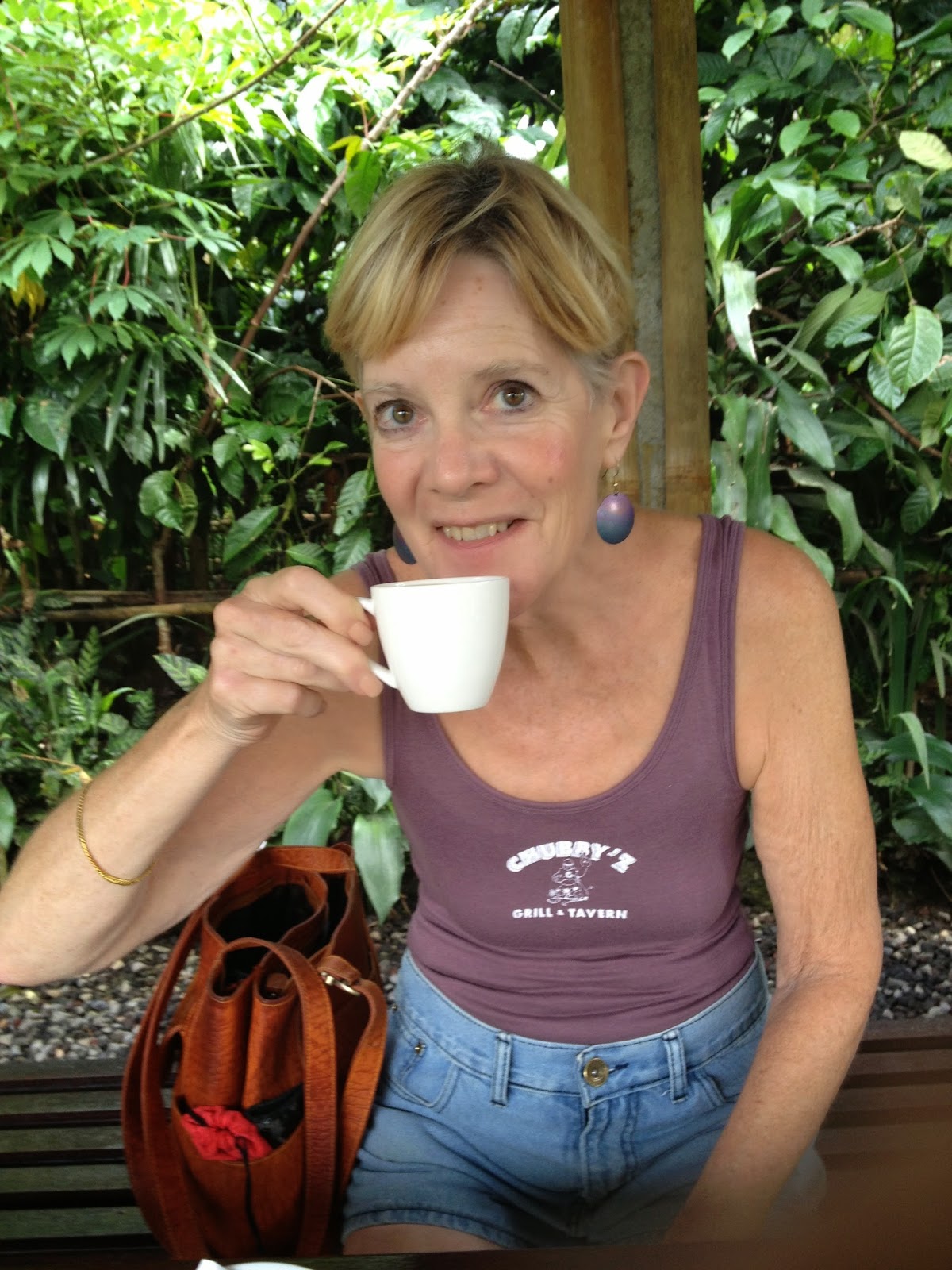
It coursed as quickly through my system as it had through the lewaks', and a visit to the farm's rustic toilet left me with a cut on my finger that I was unable to wash until much later in the day.
No gangrene resulted, so things don't always go wrong.


