Showing posts with label Orvieto. Show all posts

Wednesday, November 5, 2014

The faces of Orvieto

Orvieto is criss-crossed with narrow alleyways that must have been built to allow, at most, an ox cart to pass. The street next to our apartment was so narrow that I saw a truck nearly get stuck in it, like one of many heedless semis peeled open like sardine tins by the overpasses on Boston's Storrow Drive.

Often you'll pass one of these alleyways and see a single figure--a cat, a dog, an old woman, an old man--silhouetted by the light at the end. Alleys, arches, tunnels, buildings leaning up against one another, lend the town an air of cozy snugness.


We needn't get too deep into the Freudian imagery.

All this makes visitors feel, within a very short time, as if they are at home in a small town. Probably after they've been here for a week, Americans become the talk of this nevertheless goodhearted small town.

"Ah, the poor sick signora whose husband has bought out every medicine in the farmacias. See how feeble she looks!"


"The kind gentleman with the sunglasses in neon-yellow frames! I had my photo taken with him."


"They love all the cane [dogs] so much--even Signora Rita's nasty little beast."


"Haha, they take photos of cats, as if there are no cats in America!"


"They even take pictures of the grocery stores! Have they none of those in America either?"


Proprietors of your favorite hangouts will come to recognize you. After work, in fact, they patronize each other's hangouts, where you might run into them again.  Where else is there to go in such a small town?

Cafe Clandestino, in the middle of the main drag and almost always open, is a favorite hangout. We intend to ship the waiter a pair of yellow-rimmed sunglasses like Bill's--provided that the Thai bar girls don't win them all first. The Clandestino staff will tell you that the unique mix of Italian-American and big-band swing music that they play on an endless loop is the work of one Ray Gelato, whose heyday was the seventies. One of them handed me a well-worn copy of Ray's cookbook, full of stories and recipes, which I pored over for an hour. When I asked where I might buy a copy, they simply gave me their only one.


You can't stop these wonderful people from giving you things--from lemons to books to the delectable free appetizers that accompany all drinks.


After we had shared chips with his little boy, Leonardo, Anthony, owner of the Blue Bar, kept urging us to share a bite of his dinner panini, eventually forced a chocolate croissant on us for breakfast, and took a photo of our crew of new pals, behind the bar preparing him a drink.

Is this photo really moving? I think Orvietan magic has turned my blog into The Daily Prophet, the animated newspaper from Harry Potter.

Anthony, a former Club Med operator, has an open personality that draws in tourists, other local business owners like barber Vito (above, center), and other restaurateurs, after they've closed for the night. Go home and collapse after dinner rush? No, no, go for a nightcap at the Blue Bar or VinCafe!

Chef memoirs are not unique to Ray Gelato.  One local chef, whom you might see at VinCafe after hours, has coauthored The Etruscan Chef, a combination recipe book and florid love story, with his new partner--a cultured young Boston woman who, unwittingly following Elizabeth Gilbert's Eat, Pray, Love path up to a point, came to Orvieto, fell in love, and stayed, as Chef Lorenzo's partner. The two now manage a countryside farm B&B called Casa Segreta, an Etruscan cooking school, and a five-star restaurant.


Sunday, October 26, 2014

The magic of Orvieto


You can spend a lot of money in the high-fashion shops that have taken over every space on Orvieto's main drag, Corso Cavour, as well as every other narrow, cobbled alleyway that branches organically off it. These medieval corridors defy any concept of "grid," making it very easy to get lost and follow endless circles in Orvieto. This is part of the place's magic. The labyrinth leads you where you need to go.

Of course it would. Here's the explanation. A miracle was proclaimed here in 1263, after a skeptical German priest questioned that the consecrated host was truly the body of Christ. While the priest celebrated Mass in the nearby town of Bolsena, no sooner had he uttered the consecration than the host began to bleed, dripping onto the altar cloth. Proclaimed the Miracle of Bolsena, the cloth is still enshrined in the Duomo of Orvieto.

Like Starbucks in New York City and Dunkins in Boston, there must be at least four United Colors of Benetton within three blocks of our apartment. Orvieto thought I needed a few items there, so I obliged.

Even Bill seemed, for a moment, enchanted with this smart jacket. He needs something suitable to wear to his youngest daughter's wedding in April. This could be it. It comes complete with boutonniere!

When we first passed one shop, we assumed it was under construction. I hesitated to go in. It looked like a work in progress, a reconstruction after an earthquake. Huge curls of sawdust covered the floor and the interior. Furniture and handbags were scattered randomly among wrapped bales of hay. But many things had price tags on, so some business must be afoot here. It was a puzzle.

In fact, it was Bottega Michelangeli.

This unique storefront, with no sign of human attendants, may be the only brick-and-mortar portal for customers. The workshop itself is in a nineteenth-century theater. The storefront probably works its uniquely subtle marketing magic by intriguing clients so much that they will seek out Bottega Michelangeli online, as I did.
Like  many other parts of Orvieto, this shop is a marriage of the traditional and the ultramodern, the product of five generations of a woodworking family. One of its website's historic photos shows a woodworker's bench with a carafe and two glasses off to one side, Its website describes its work as "a combination of alchemical experience and creativity," in which the spirit of all carvings, products, interior design, and architecture is allowed to emerge. Picture a flat, wood-carved form of Italian marble sculpture, Marcus Aurelius on a Trojan horse. They've also branched out into a third dimension, doll making, but the three young Italian women captured in a photograph with one of their rounder creations appear to be apprehensive that it might come to life. Too much alchemy can be a powerful thing.


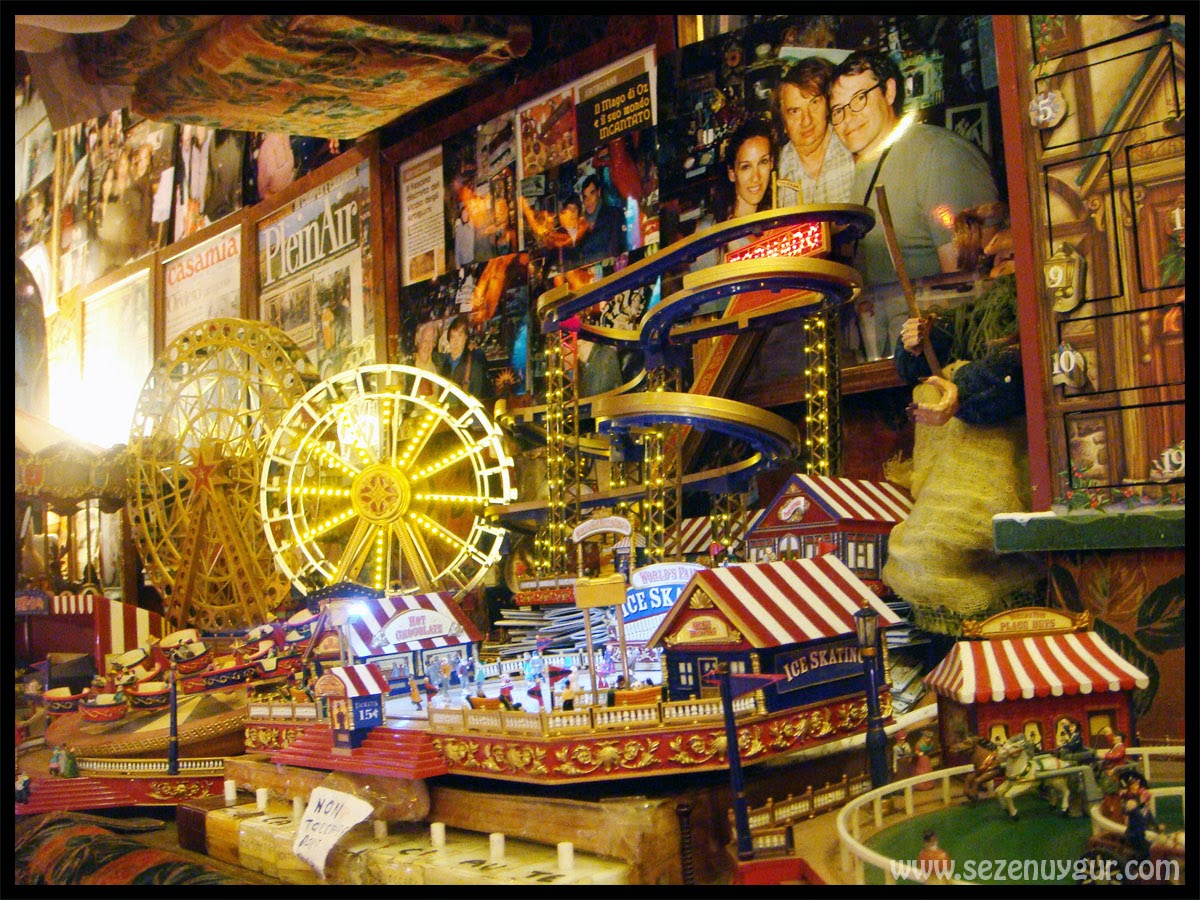
Some side streets seem devoted to particular trades, as you'd expect in a medieval town. For example, there is what I'd call Street of Artisans, off the right-hand side of Via Duomo, on Via dei Magoni. One might think this means Street of Wizards, because of its most prominent shop, Mago di Oz, but no, this was originally Street of Gizzards. Given the limited demand for gizzards these days, never mind the need for a whole street devoted to them, artisans have set up shop here. Surely the most unique of these is Giuseppe Rosella, who calls himself Il Mago di Oz (the Wizard of Oz) yet will completely miss the reference "We're not in Kansas any more."  No matter. The Betty Boops throughout his shop, the Oz references, the frilly masks, and the over-the-top flamboyance of the displays all make their point in Orvieto's own subtle, magical way. It is said that if you touch any part of the shop, all the toys will begin to play, and when you wave your hands, they will fall silent.

"Sono io!"
Giuseppe's shop has been a required stop for years of celebrity tourists, and he was proud to point out that Rick Steves's guidebook profiles him.


Saturday, October 25, 2014

Even the birds sing in Italian

After listening to the lilt of Italian for a week, perhaps even learning a few new words, everything begins to sound like Italian--from the washing machine in our apartment to the blackbirds and doves flying over Orvieto's medieval alleyways. Mary, a fellow American tourist from Philadelphia, agreed with me, lending me the title of this post.

This lyrical language might be the only world tongue that was purposely invented to unite dozens of competing local dialects. It didn't just happen over time. An Italian creation born from the poetry of Renaissance masters like Dante, Petrarch, and Boccaccio, it could have been based on the cadences of the country's birds, too. But it also isn't hard to imagine that these creatures simply can't help imitating the speech patterns of Umbria.

Italian birdsong

I know French and Spanish far better than Italian. And because I've worked for years on music appreciation textbooks, my Italian is based largely on music directions, such as fortissimo, fermata, crescendo, and the like. This is not a recommended way to make yourself understood in Italian. I must have puzzled a local shop owner terribly when I asked when he was "fermata" (closed). The correct word is chiuso. God only knows what I really said. This is an important question to ask, though, because many shops close for a riposo, a civilized two- or three-hour southern European afternoon siesta that would horrify any respectable American business.

Opera lyrics are a bit more helpful, but in a similarly skewed way. Thanks to Mozart's opera Don Giovanni, I can now ask someone to give me their hand and come along with me, that our destination is not far.

"Give me your hand, dearest" from Don Giovanni

I'm a bit hesitant to use this, however, because the lyrics come from a classic seduction scene in the opera. I'd probably be better off announcing that you invited me to dinner, and here I am, dammit, from the same opera. (Don't ask. It's a long story.)

"You invited me to dinner; here I am!" from Don Giovanni

Every girl should know how to admit, like Violetta in Verdi's La traviata, "Ah, perhaps he is the one!"

"Perhaps he's the one" from La traviata

And any sensitive guy should be able to tell his Italian date what cold little hands she has and that he would be happy to warm them for her. Guys who try this should first determine that their date knows nothing about Puccini or La boheme, however. Otherwise, they're busted.

"What cold little hands" from La boheme

By the way, if you're wondering why an Austrian composer who also wrote Die Zauberflote would create an opera with Italian lyrics, the librettist was an Italian, Lorenzo da Ponte. There may be other reasons.  I'm open to finding them out, but Google failed me.